
Wayne County Deed Records and What They Show
The Recorder/Treasurer is the custodian Wayne County names for its deed records. The same office holds mortgages, releases, liens, and plats. Ask the staff which index categories exist. Also ask whether a given instrument has an electronic image or just a book-and-page reference. Each type does different work. A deed records a transfer of ownership. A mortgage or lien records a claim against the property. A release or reconveyance can show that a claim was cleared later. Index labels and copy fees change, so confirm current details with the office directly.
| Deed Type | What It Does | Common Use |
|---|---|---|
| Deed or conveyance | Records a transfer and parties | Confirm the exact instrument and legal description |
| Mortgage or deed of trust | Records a secured claim on land | Look for a later release or reconveyance |
| Release or reconveyance | References a prior recorded claim | Match the original instrument and parcel |
| Lien | Records a claim that may be enforced | Check later releases and related court cases |
| Plat | Shows the recorded lot and block layout | Read with the deed, not as a survey |
Not every recorded item changes ownership. That distinction matters. A deed names a grantor and a grantee, and it stands on its own. A later mortgage, lien, release, or court order can affect the record. It does so without altering the deed itself. In Wayne County, the Recorder/Treasurer is the first custodian for that instrument trail. A court case summary is only a clue to litigation. It does not prove a recorded claim is still active.
Request a Wayne County Deed Search at the Recorder Counter
Wayne County publishes no online deed index. The deed records live at the courthouse at 18 S Main in Loa. The Recorder/Treasurer answers at 435-836-1303. Call or visit. Ask how to reach the grantor-grantee index. Find out which years it covers. Ask whether staff can search by tax serial or legal description. Ask too how to get an image or certified copy. A 2019 fee-schedule link may still appear online. That alone promises nothing about a searchable index or images today.
County offices generally run 8 a.m. to 5 p.m. on weekdays. They close 12:30 to 1 p.m. for lunch. For current contact details, the Recorder/Treasurer office page is the authoritative source. Confirm fees and copy procedures with staff before ordering.
Fields to Ask for in a Wayne County Recorder Index Entry
Wayne County has no confirmed online index. When you request an entry, ask the Recorder for the full picture. That means grantor and grantee names. It also means instrument type, recording date and time, and the document or entry number. Ask for the tax serial or legal-description link, plus any book/page or image reference. Then check whether the item points to an earlier instrument or a later release. Find out if a plain or certified copy is available.
| Parties | Grantor and grantee as written in the recorded instrument |
|---|---|
| Record reference | Document or entry number, book/page, and recording date |
| Land key | Parcel serial, tax number, or full legal description if indexed |
| Image and cross-reference | Ask about copy access and prior or release references |
Utah recorder training draws on these concepts statewide, but that says nothing about Wayne County's own index fields or whether any online index exists at all.
The Wayne County Grantor-Grantee Index
Start with the newest deed into the owner shown on the Assessor's record. The grantee received the interest. The grantor conveyed it. Now take that grantor's name and search it as an earlier grantee, keeping the same parcel serial or legal description in view. This chain-walking moves you backward through ownership one instrument at a time. Wayne County's index cutoff and online coverage are not published, so when the trail reaches an older volume, ask the Recorder/Treasurer what comes next.
- Find the latest conveyance naming the current record owner as grantee.
- Read the grantor and copy the legal description and parcel reference.
- Search that grantor as a grantee in an earlier transfer for the same land.
- Repeat until the index or book range ends, then ask for the older volume or archive path.
- Grantor
- The party named as conveying an interest.
- Grantee
- The party named as receiving an interest.
- Chain of title
- The sequence of recorded transfers tied to the same land.
- Book/page or instrument number
- Two ways a custodian may point to a filed document; ask which Wayne uses for the item.
Match Wayne County Deeds by Legal Description
A street address is a weak key for an older rural deed. Wayne County records may describe land several ways. It could be a lot and block, a named subdivision, acreage, a section-township-range, or metes and bounds. Copy the whole description. Compare it against the plat or survey reference. Do not rely on a town name or postal ZIP. Parcel serials can change when land is split or reconfigured. A current number may not be the only identifier in an older instrument.
Keep your notes tight. Record the deed's document number, recording date, parties, and the complete land description together. A grantor-grantee search finds instruments tied to names. The description tells you whether a document covers the property you actually mean. If the tract was divided, compare the parent description with later deeds. Check any filed plat too. One caution: a name match alone can pull an unrelated parcel. This happens especially when someone has held land in more than one community.
County subdivision review demands an engineered survey and a dedicated map. It also requires water, wastewater, access, fire, ownership, and tax-clearance materials. The Wayne County Planning and Zoning page spells out those local requirements. A subdivision plat helps you interpret a deed description. It will not settle a boundary dispute on the ground.
Older Wayne County Deed Books and Archive Paths
Wayne County split from eastern Piute County in 1892. Settlement in the Fremont and Rabbit Valley region goes back to the 1870s. Loa's townsite was surveyed in 1878. The county has not published its first deed-book year, its book runs, or its microfilm holdings. So the shelf locations of the oldest volumes remain an office matter. Start with the Recorder's earliest grantor-grantee index and the matching original books. Then check the Utah State Archives for a government series or transferred court material.
The Utah Archives research portal holds name indexes, digital collections, and series inventories. Wayne County Public Library offers in-library Ancestry access covering land, probate, directories, and court records. No local directory year run appears in its published holdings.
Ask the Recorder which index volume covers your transfer year. Find out whether a book-and-page citation, an instrument number, or another local reference will pull the original deed record. Never assume an online index reaches back to 1892. Digitization of every older book is not guaranteed. If the office points you to an archive series, note the agency, title, date span, and call number. That detail makes any later request precise.
Check Wayne County Court Cases for a Recorded Lien Dispute
A mechanic's lien, foreclosure, partition, or quiet-title fight can travel from the land index straight into court. Utah Courts Xchange provides public district and justice case summaries. Search the owner, contractor, lender, estate, or entity name. Then scan the case history for a complaint, judgment, release, dismissal, or sale order. A Xchange result is only a summary. Confirm any order or continuing encumbrance in the recorded land record itself.
The Xchange field guide explains the search and result fields. These include party, court, case type, filing date, and document links. Loa's district system connection dates to February 24, 2000. Earlier justice-court data may be incomplete. Sealed, expunged, juvenile, adoption, and other protected cases are excluded from public summaries.
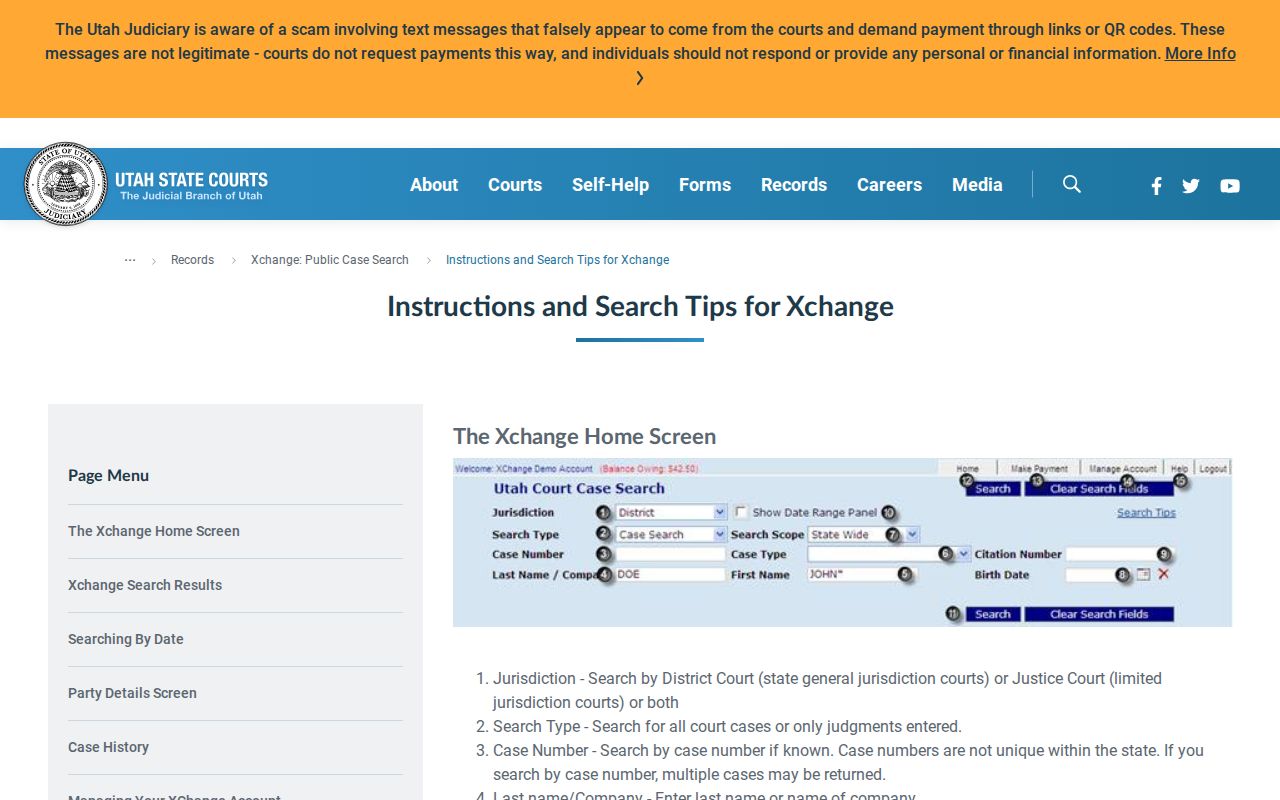
Utah court guidance also lists courthouse public terminals and document-image charges. Check the current Xchange page before opening files.
Getting a Copy of a Wayne County Deed
Contact the Recorder/Treasurer with the parties, an approximate recording date, the tax serial, and the legal description. Ask whether staff can locate the instrument by phone. An in-person counter search may also be required. Also ask whether a plain or certified copy can go out by mail. The county's posted material links a 2019 fee schedule. Current search, copy, recording, and certification amounts are not stated there. Confirm the fee and the accepted payment method before sending any money or deed request.
Recorded, not guaranteed. A recorded Wayne County deed is evidence of the filing and its stated transfer, not a title opinion. Search releases and later instruments too, and use a title professional when a complete ownership conclusion is needed.